Module 2 – Female Hormones Part 1
As females, we have a lot to contend with – some more than others. Between menstruation, to pregnancy, to hormone imbalances, to perimenopause, and everything else that comes along for the ride like; adrenal issues, low thyroid, weight gain, migraines, gallbladder issues, toxic overload… need I go on?
Needless to say, us women have a lot to deal with when I comes to our body and hormonal system, but one thing that can help is “understanding”. Understanding whats going on, how to self diagnose (because lets be honest, the health care professionals are not always up to scratch), and how to address said issues.
SELF KNOWLEDGE MEANS AWARENESS AND BODY LITERACY.
There are many aspects to the female hormonal system, but ‘for now’ we will just focus on or learn about;
What a normal period should be like
Heavy and painful periods
Bleeding between periods
No periods or Amenorrhea
Premenstrual symptoms or PMS
Perimenopause and menoupause
WHAT A NORMAL PERIOD SHOULD LOOK LIKE.
First thing to understand here is that a normal period/menses should not be painful or make your life difficult. A normal period should flow easily, have minimal blood cloths, with a normal flow and fresh red blood. You should still be able to go about your daily life when on your menses.
You don’t have to have a perfect 28-day cycle. As long your period starts every 21 to 35 days, you have a healthy cycle. It can even vary a little month to month (by more than eight days at a time).
Your actual bleeding should last between 2 and 7 days, and you don’t want to lose more than 80 mL of menstrual fluid over all the days. A regular tampon holds 5 mL so you can fill 16 tampons and still be in the norm. More than that is considered a heavy period.
The first half of your period is about making Estrogen and the second half is about making Progesterone. Note; If you have low progesterone, this could be from not ovulating (anovulation), stress, or other physical factors like fibroids.
The timing of a healthy period is the sum of three phases;
the follicular phase, which can last anywhere from 7-21 days
ovulation, which lasts 3-4 days, peaking in the middle around day 2 (this is an all or nothing event, you either ovulate or you don’t).
the luteal phase, which lasts 10 days or so.
If your an adult this all adds up to between 21-35 days. If your a teenager though, your cycle can be longer because your follicular phase can last as long as 32 days.
28 days is the average but not the rule.
HEAVY AND PAINFUL PERIODS.
HEAVY and painful periods are very common and many women believe they are “normal”. Definitely not!
If you bleed for more than seven days, or lose more than 80 mL of menstrual fluid (16 fully soaked regular tampons), then you have a heavy period. Please see your doctor so they can rule out possible causes such as as fibroids, clotting disorders and thyroid disease.
The most common cause of heavy painful clotty periods is due to “Estrogen dominance”, you may have heard of this already. This is where your Estrogen is higher than your Progesterone. So your hormonal ratios are off.
Causes of estrogen dominance are;
hypothyroidism
systemic inflammation
obesity
poor nutrition
calorie restriction
sedentary lifestyle
liver issues
gut issues
malfunctioning detoxification pathways
chronic stress
poor sleep
birth control
toxic overload
FIX; change nutriton to support fat loss (if needed), reduce inflammation, support thyroid and detoxification pathways (refer to module 1), and rebalance hormones. Low dose Aspirin, bio identical Progesterone, DHEA, and Vitamin C will help boost progesterone and improve your resiliency to stress which contributes to the “progesterone steal” AKA “the pregnenolone steal”. Chasteberry or Vitex can also bring up progesterone while helping push down excess estrogen production. Vitamin E can also help reduce excess estrogen. Make sure you sleep well to spin down inflammation, insulin resistance and further stress.
PAIN can mean a lot of different things – anything from run of the mill pain, to infections or endometriosis. Normal period pain (a dull ache), is caused by the release of “prostaglandins” and histamine in the uterus. They cause the uterus to contract and release the endometrial tissue. Having more estrogen and less progesterone can cause a higher level of prostaglandins and histamine, thus more pain.
More commonly, the pain we experience with our menses is usually down to two things;
Big sticky blood clots trying to pass through tiny blood vessels – the blood and tissues are inflammed and gluggy/sticky, which causes pressure and pain, as it passes through your reproductive system to be excreted. FIX; good nutrition, anti inflammatiories like Magnesium, Krill, Vitamin C (also boosts progesterone), Zinc, Turmeric, Chasteberry or Vitex. Support detoxification pathways.
Histamine intolerance is another cause of period pain. Having too much of the inflammatory compound histamine can increase inflammation, estrogen, and swelling. FIX; Quercitin, Serrapeptase, Identify histamine causing foods or substances. There is a leaflet/PDF in the files section of the forum that can help if a histamine issue has been confirmed. Also hitamine food list and meal plan/recommendations. You must support detoxification processes daily!
If you suffer from heavy periods, you may have become deficient in iron…please talk to your doctor about a blood test and test copper too if possible. Copper deficiency can cause iron issues. B vitamins and Chlorophyll (rich in copper) also support blood production and hemoglobin, so should be considered too.
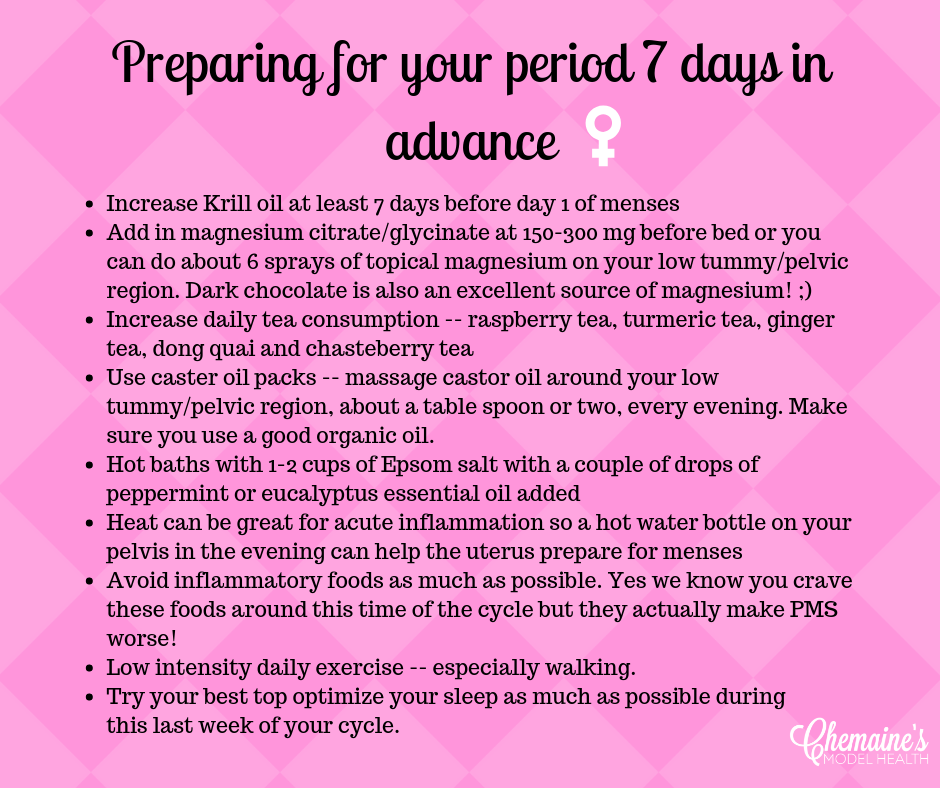
♦ The directions in this infograph are very effective at helping your body prepare for your period 7 days in advance. Use it! There is also a video in my biohacking group that describes this infogrraph and how to support a good menstrual cycle all month. Feel free to share or tag your loved ones and friends in the video.
PREMENSTRUAL SYNDROME or PMS
Next we come to the fun part – to the irritability, cravings and other fun stuff you may experience 7-10 days before your period. The first thing to understand is that PMS can become a thing of the past. No irritability. No headaches or migraines. No food cravings. It is possible!
Many times I have had clients say to me “I was surprised when my period arrived, I didn’t even feel it coming”.
PMS referes to a large and varying set of symptoms we can experience before our menses starts. To qualify for PMS, symptoms must occur during the 10 days before your period and then disappear during or shortly after your bleed. The most commonly reported symptoms are;
irritability
anxiety
depression
weepiness
brain fog
sleep disturbance
fluid retention
bloating
constipation
heart palpitations
joint aches and pains
headaches and migraines
food cravings
breast pain and tenderness
acne or pimples
What causes PMS? PMS is generally caused by fluctuations in hormones but more specifically low progesterone. Along with histmaine intolerance (listen to the podcast below), hormonal brith control, stress, toxic overload, and inflammation. Food sensitivites can also cause PMS (due to the histamine and inflammatory response).
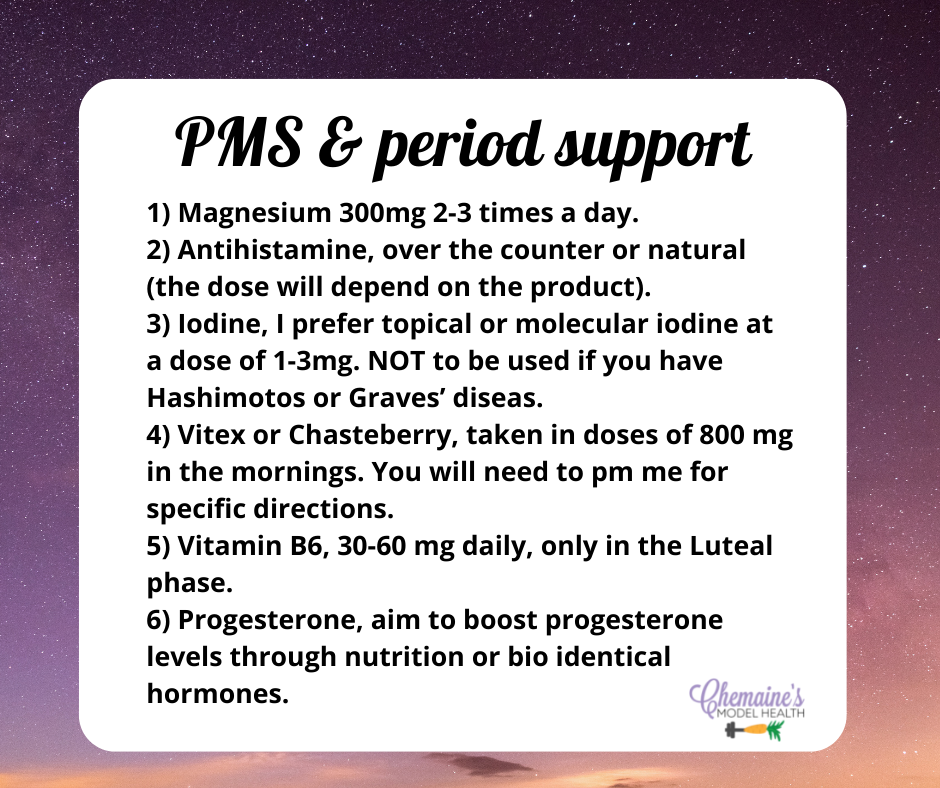
FIX; PMS responds very well to magnesium and even anti histamines. In some people, magnesium deficiency may actually be the main cause of PMS. Chasteberry or Vitex is also effective. But your biggest tools for addressing PMS is going to be reducing inflammation through nutrition, fasting and sleep. Exercise helps greatly with PMS and other supplements like vitamin B6, vitamin C, Iodine, Calcium d-glucarate, and Zinc. At a certain point you may need to try some bio identical “topical” progesterone.
More resources;